Mark Moore


White Papers

Longer research papers and formal responses to consultations, newest first. Each can be read in summary here and downloaded in full as a PDF.

You are welcome to share these papers or quote from them, with attribution to Mark Moore and a link to markdmoore.co.uk.

Consultation response

Response to Ofgem’s Transforming the Connections Experience consultation

Submitted 30 October 2026 · Consultancy response · Non-confidential

Ofgem has decided to strengthen service standards for connecting customers and to publish how often network companies meet connection dates, why delays occur and whether the causes were within their control. I support the decisions, and show that the published connections data records neither the cause of a delay nor the history of a date, while the companion data reform does not propose a delay reason field. The response answers five of the eight questions and is intended to be read with my response to the Transforming Connections Data consultation.

The proposal: one reason code, recorded once

A single controlled list of change and delay reasons, recorded by the network company when a connection date changes, each marked as within or outside its control.

The same code carried in the public registers and used, without restatement, for Guaranteed Standards of Performance exemptions, liquidated damages for transmission and the new performance reporting.

The previous planned connection date and a data correction flag retained, so that trends can be reported and corrections are not counted as delays.

  • ConsultationOfgem, Transforming the Connections Experience: 2026 policy consultation
  • Published25 September 2026
  • Closes6 November 2026
  • Response submitted30 October 2026, by email

Download the full response (PDF, 6 pages)

The text is as submitted, set out in this format in place of Ofgem’s response template, with my email address taken out. Ofgem’s consultation page
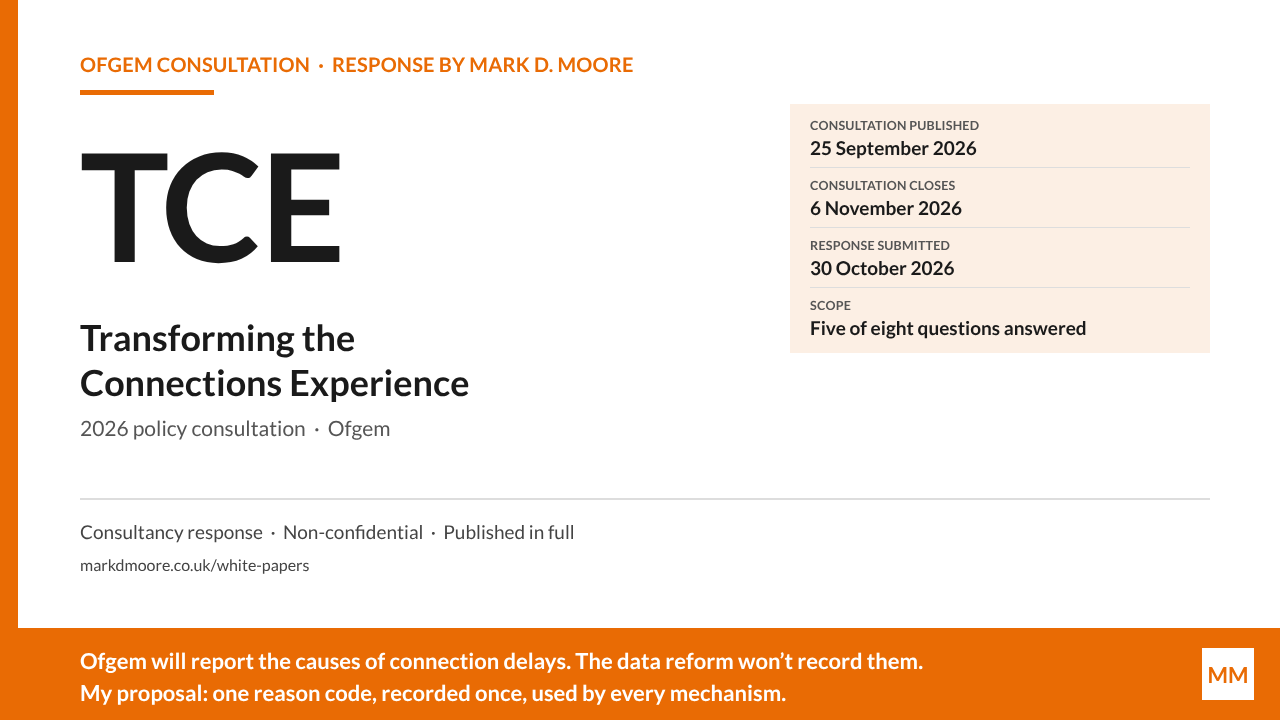
Transforming the Connections Experience: response by Mark D. Moore to Ofgem's 2026 policy consultation, submitted 30 October 2026

Consultation response

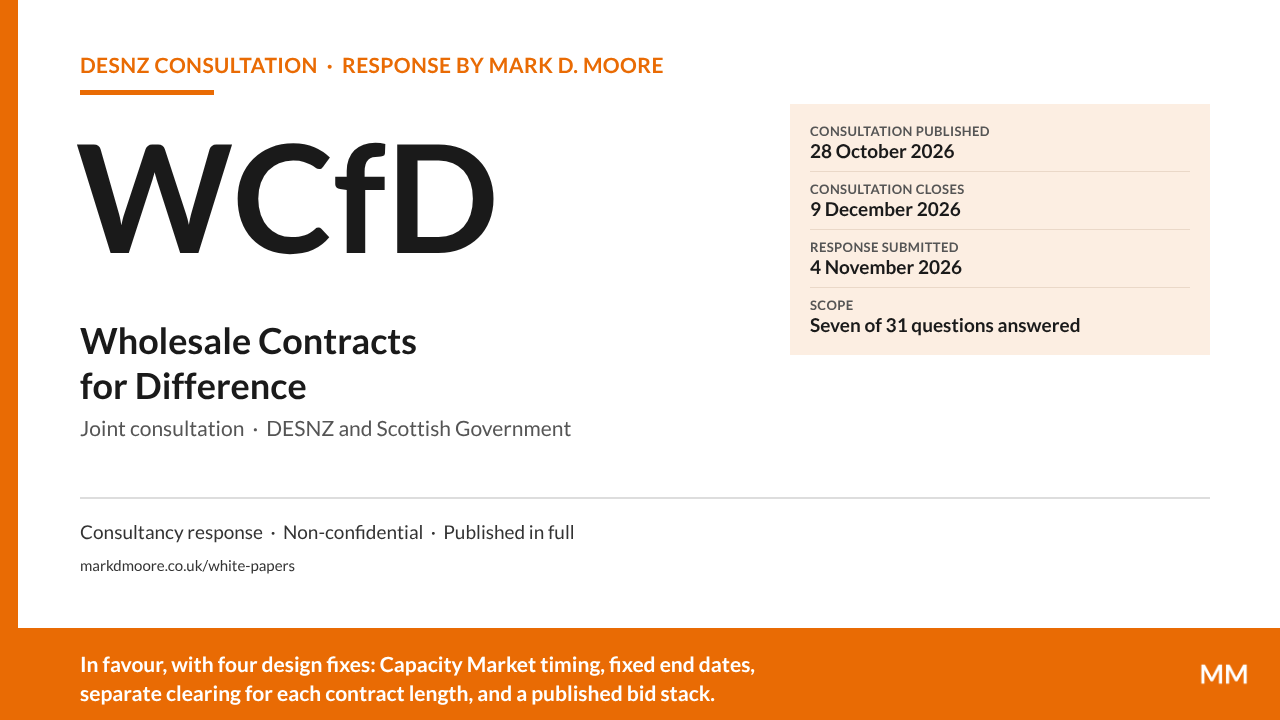
Response to the Wholesale Contracts for Difference consultation

Submitted 4 November 2026 · Consultancy response · Non-confidential

DESNZ and the Scottish Government propose a voluntary fixed-price contract for the wholesale revenue of existing wind, solar and hydro, allocated in a one-off pay-as-clear auction, with RO support left in place. I support the scheme in principle. Whether it delivers value turns on four design points: a Capacity Market transfer notice that falls due before the expected auction, a start date rule that does not reward delay, separate clearing for 5-year and 10-year contracts, and publication of the bid stack. The response answers seven of the 31 questions.

The four design proposals

A shorter Capacity Market transfer notice for the WCfD round. On the consultation’s own example, the notice for the delivery year starting 1 October 2028 is due on 1 June 2027, months before the auction is expected.

A start date window with the contract end date fixed, so that a generator starting later receives a shorter contract at the same strike price and delay carries a cost.

Separate clearing for each contract length. A 5-year bid and a 10-year bid price different periods, and one pay-as-clear price for both would overpay one group of winners.

The test applied to the bid stack published before the round, and the anonymised bid stack published after it, so that the discount generators accept for certainty can be measured.

  • ConsultationDESNZ and Scottish Government, Wholesale Contracts for Difference
  • Published28 October 2026
  • Closes9 December 2026
  • Response submitted4 November 2026, by email

Download the full response (PDF, 6 pages)

The text is as submitted, with my email address taken out. The consultation on GOV.UK

Wholesale Contracts for Difference: response by Mark D. Moore to the DESNZ and Scottish Government consultation, submitted 4 November 2026

Consultation response

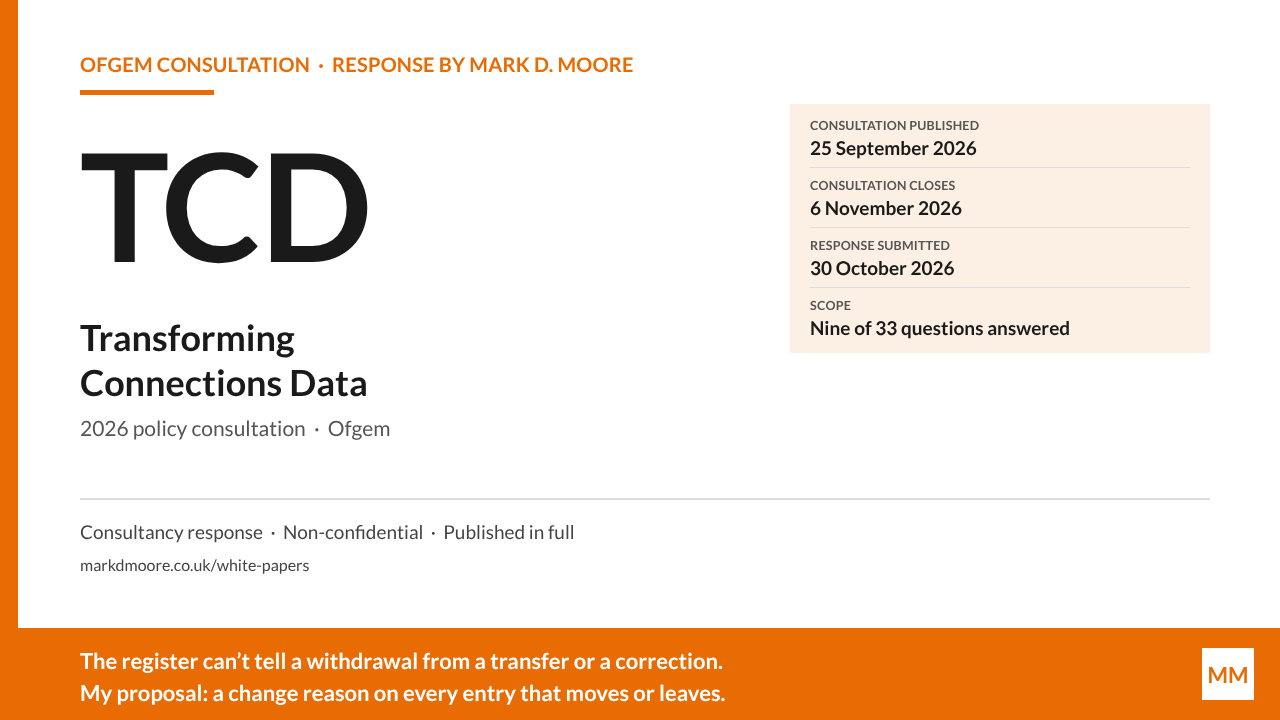
Response to Ofgem’s Transforming Connections Data consultation

Submitted 30 October 2026 · Consultancy response · Non-confidential

Ofgem proposes stable identifiers, last-modified dates and retained connection dates for the TEC Register, but decided against a field giving the reason a project changed or left, on the grounds that it can be inferred. I support the proposals and show from a snapshot series of the published register that it cannot: a user cannot tell a withdrawal from a transfer, a re-keying or a data correction, and connection dates move back and forth between editions without trace. The response answers nine of the 33 questions, drawing also on SSEN’s Embedded Capacity Register and on the regulatory dates of the ASTI transmission projects.

The three proposals for the TEC Register

A single change or exit reason on each entry that changes or leaves the register: withdrawn or terminated; transferred to a new customer or project company; re-keyed, split or merged; moved to another register; data correction; connected. NESO knows which of these has happened in each case.

A correction flag and a change log published with every edition. NESO confirmed in September 2026 that neither exists today. Ofgem already proposes a correction flag for the new Demand Capacity Register.

The previous planned connection date alongside the current one, so that a date which has moved, or moved back, can be seen without holding every past file.

  • ConsultationOfgem, Transforming Connections Data: 2026 policy consultation
  • Published25 September 2026
  • Closes6 November 2026
  • Response submitted30 October 2026, by email

Download the full response (PDF, 9 pages)

The text is as submitted, set out in this format in place of Ofgem’s response template, with my email address taken out. Ofgem’s consultation page
Transforming Connections Data: response by Mark D. Moore to Ofgem's 2026 policy consultation, submitted 30 October 2026

Consultation response

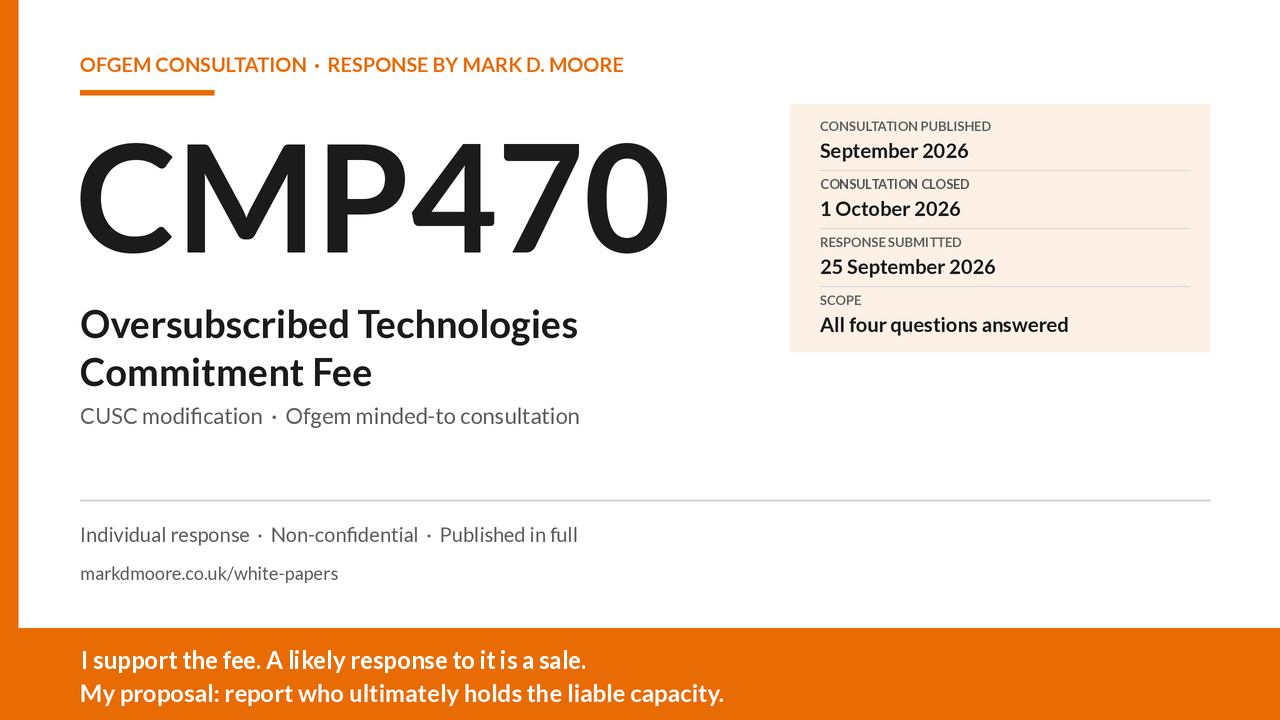
Response to Ofgem’s minded-to consultation on CMP470: Oversubscribed Technologies Commitment Fee

Submitted 25 September 2026 · Individual response · Non-confidential

I support the intervention and the Original Proposal. The response addresses all four questions, with evidence under Question 3(ii) that a likely behavioural response to the fee is a change of control of the project company, which the TEC Register does not record. Under Question 4 I propose ultimate-ownership reporting for OTCF-liable projects and a post-implementation review of the conclusion at paragraph 5.14, and I ask for clarification on projects converting from battery storage to demand and on demand-led sites that add export-capable storage.

The two proposals in the response

I propose that NESO collect the ultimate controlling party of each OTCF-liable project when securities statements are issued, and that Ofgem receive an aggregated view of how the liable capacity is held. The first statement is expected in July 2027 (paragraph 3.23), which gives time to add the field. The data need not be published at project level. An aggregate measure, such as the share of liable capacity held by the largest owners, would be enough to test the competition conclusion.

I propose a review after the first two escalation points, testing whether the conclusion at paragraph 5.14 has held. The review would compare the ownership concentration of the liable capacity at activation with its concentration at review, and set exits against changes of control. Without the reporting proposed above, that comparison cannot be made.

  • ConsultationOfgem, minded-to consultation on CUSC modification CMP470: Introducing an Oversubscribed Technologies Commitment Fee
  • PublishedSeptember 2026
  • Closed1 October 2026
  • Response submitted25 September 2026, by email

Download the full response (PDF, 7 pages)

The text is as submitted, except that an unfinished drafting note in paragraph 13 has been removed, the date completed and my email address taken out. The article Why does CMP470 make sense? sets out the same argument. Ofgem’s consultation page

CMP470, Oversubscribed Technologies Commitment Fee: response by Mark D. Moore to Ofgem's minded-to consultation, submitted 25 September 2026

Consultation response

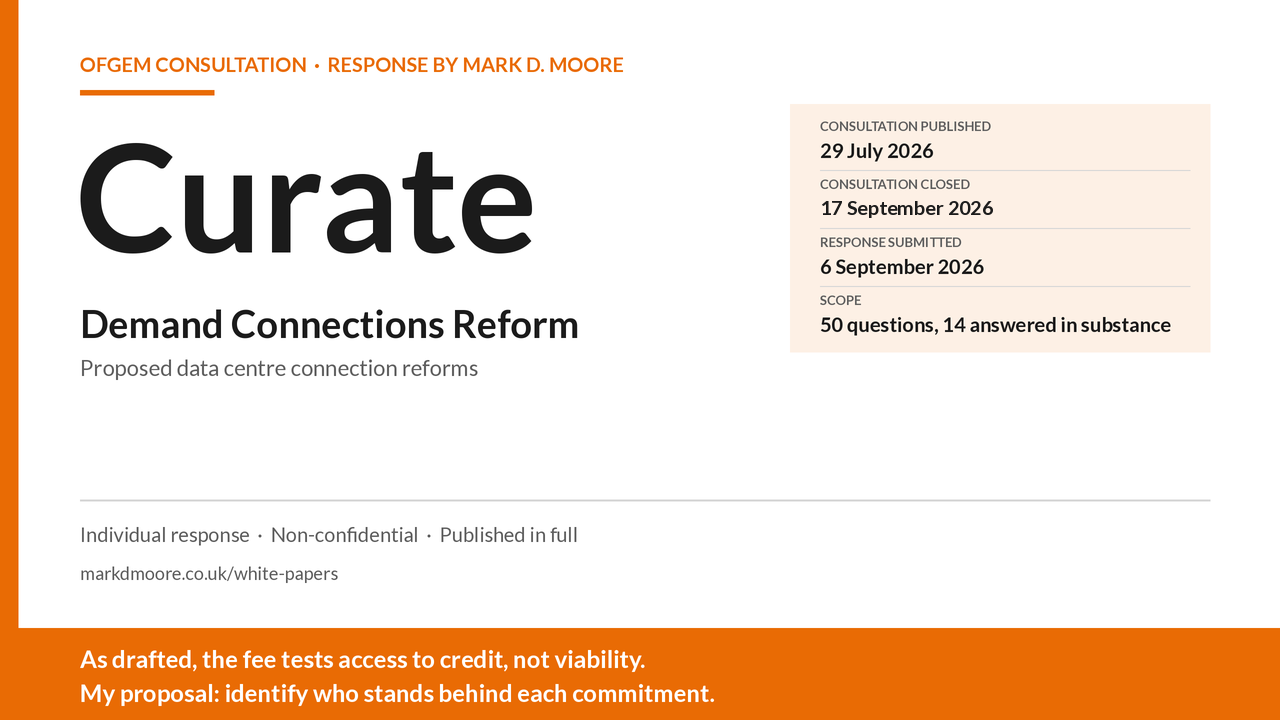
Response to Ofgem’s Curate consultation: Demand Connections Reform

Submitted 6 September 2026 · Individual response · Non-confidential

Curate proposes a commitment fee for data centre projects of 40 MW and above, together with queue management milestones and evidence of financial capability. I support the fee, its 2.5 to 7.5 per cent range and the 40 MW threshold. My central point is that the fee may be secured by a bond or letter of credit, so as drafted it tests access to credit rather than project viability. A well-capitalised group can hold a speculative position cheaply, while a viable but thinly capitalised project may not. Neither the self-declaration route nor the credit support rules require anyone to establish who ultimately stands behind a commitment. I propose a stated standard for identifying the ultimate controlling party, using Companies House data that is already public.

Other points in the response

The fee threshold is defined in the drafted code as connection capacity, but the consultation narrative describes it in rated IT load. The two differ once cooling and redundancy are counted, and the drafted code should govern.

The queue management milestones are consulted on at 10 MW rated IT load. The drafted definition of a Data Centre Service keeps 10 MW only for enterprise facilities. For colocation, and for any facility serving third-party customers, the drafted threshold is 1 MW.

Ireland is the closest comparator to Great Britain and is not analysed. The Commission for Regulation of Utilities decision of December 2025 attaches conditions to the connection itself and uses no commitment fee. I asked whether that approach was considered.

Ofgem’s own figures show reformed securities averaging 0.2 per cent of capital expenditure. That comparison does more to justify the fee range than the IRR case study does.

  • ConsultationOfgem, Curate: Demand Connections Reform (proposed data centre connection reforms)
  • Published29 July 2026
  • Closed17 September 2026
  • Response submitted6 September 2026, on Ofgem’s response template

Download the full response (PDF, 25 pages)

The text is as submitted. Telephone number and email address have been removed from this copy. Ofgem’s consultation page

Curate, Demand Connections Reform: response by Mark D. Moore to Ofgem's consultation, submitted 6 September 2026

Working paper

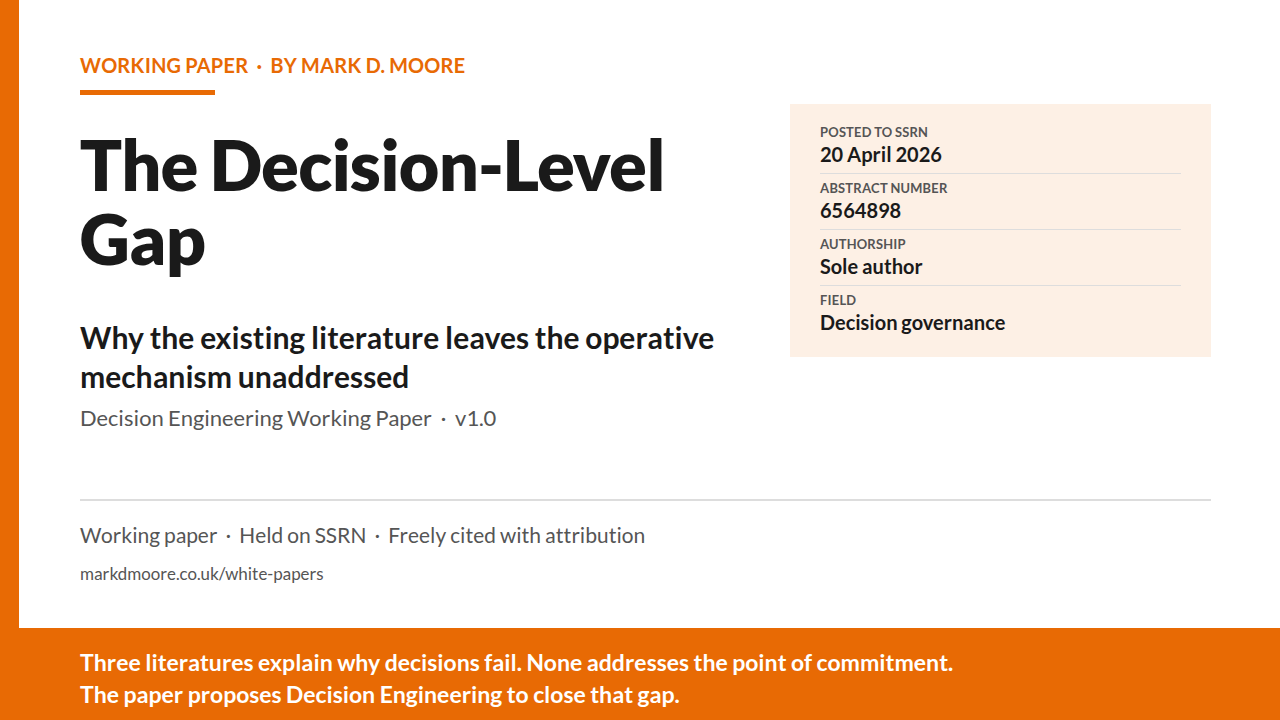
The Decision-Level Gap: why the existing literature leaves the operative mechanism unaddressed, and what Decision Engineering provides

Posted to SSRN 20 April 2026 · Decision Engineering Working Paper, v1.0 · Abstract number 6564898

Three substantial bodies of literature document the systematic failure of decisions in complex markets. Behavioural economics explains cognitive failure at the individual level. Institutional economics explains structural failure at the organisational level. The consolidation literature (Philippon, Wu, Zuboff) explains systemic failure at the market level. Each is rigorous within its scope. None addresses the specific point at which ungoverned assumptions become irrevocable commitments. That gap, the decision level, is where the mechanisms all three traditions document are actually produced.

What the paper proposes

The paper proposes Decision Engineering as the operational architecture that closes the gap. The framework derives from five established intellectual traditions, has been tested across four decades of commercial practice, and is grounded in applied case evidence across healthcare procurement, contaminated land remediation, offshore manufacturing and energy infrastructure. The paper sets out its theoretical foundations, locates it within the existing literature, and identifies the implications for governance practice in markets where decision failure is both systematic and predictable.

  • SeriesDecision Engineering Working Paper, version 1.0, April 2026
  • Posted20 April 2026, SSRN
  • Abstract number6564898
  • KeywordsDecision governance, institutional economics, bargaining theory, incomplete contracts, market consolidation

Read or download the paper on SSRN

The paper is held on SSRN, which is the version of record; no copy is hosted on this site. The summary is taken from the paper’s own abstract, lightly edited for this page.

The Decision-Level Gap: Decision Engineering working paper by Mark D. Moore, posted to SSRN on 20 April 2026, abstract number 6564898